
Meng Tai Eyewear/Tool Room
Tool room
Your tooling
stays here.
First shots, adjustment, milling, EDM and repair happen in our own tool room, in the same building as the presses that run your mold. Once it is here it stays here, and it is maintained by the people who run it.
Where a schedule is actually lost
Most tooling problems do not appear on a drawing. They appear on the first shot: a radius that will not fill, a witness line in the wrong place, an ejector mark where the paint will show it, a texture that reads differently on the real material than it did on the plate.
Each one of those needs the mold opened, looked at, altered and tried again. That loop is where a development program quietly loses weeks — not in cutting the steel, but in the three or four rounds of adjustment after it.
What the tool room does
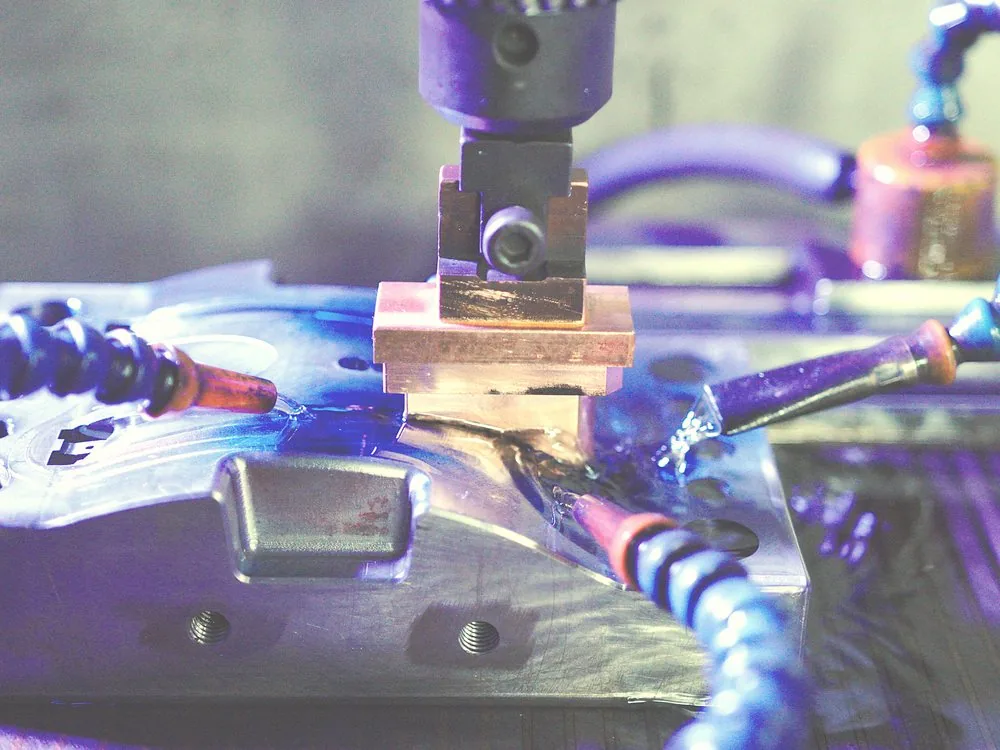
Trial shots and first-article sampling; adjustment and fitting on the mill and at the bench; EDM — sinking a copper electrode to cut the shapes a cutter cannot reach, which on eyewear means most sharp internal corners and the hinge pockets; and repair and modification of tools already in production.
Repairs are the part that gets undersold. A tool that has run a few hundred thousand shots needs attention — a worn shut-off, a damaged slide, a gate that has eroded. Those are routine here rather than an event, and they do not involve shipping your tooling anywhere.
Before the steel
Drawing, model, prototype.
A style is modelled in 2D and 3D CAD and printed as a physical prototype before a tool is committed. Steel is the expensive, slow way to discover that a temple is 2 mm too long.
Tool room
- First shots and trials
- Milling and bench fitting
- EDM (sinker)
- Repair and modification
Development
- 2D drawing
- 3D CAD model
- Printed prototype
- First shot and sampling
Whose tool is it
A tool paid for by a customer is that customer's tool. It stays here because this is where it runs, not because it is held. What happens to it if you move production elsewhere is a commercial question, and it belongs in the quotation in writing rather than in a conversation later.
If a style needs a second shot
A frame that will carry a soft grip has to be tooled for it from the start — interlocks for the soft material, wall sections that take a second cycle, a parting line that lands where the grip ends. Adding that to a tool cut for a plain hard temple usually is not possible. See over-molding.
What to send
A 2D drawing or 3D file, the material, the expected annual quantity, and whether the style already exists somewhere. Quantity is what decides cavitation, and cavitation is most of the tooling cost — a tool built for 5,000 pieces a year and one built for 100,000 are not the same tool.
Send us the design.
We will come back on tooling, cavitation and the sampling schedule.
Request a quotation