
Meng Tai Eyewear/Over-Molding
Over-molding
Bonded in the mold.
Not glued.
Soft TPR molded straight onto the hard part on eight vertical presses. The bond is formed by the second shot itself, so there is no adhesive layer to fail — and the hard part can go in painted or unpainted.
How it runs
The rigid frame or temple is molded first in PC, TR90 or nylon on a horizontal press. It is degated and tumbled. If the style calls for paint, it is painted at that point. Either way it then goes to a vertical press, where it is placed into a second mold as an insert and the soft material is shot over it. The TPR fuses to the surface while it is still molten.
Painted or unpainted
Unpainted is the straightforward route. The hard part comes off the horizontal press, is cleaned up, and goes to the vertical press as it is. Its color is the color of the resin.
Painted means the frame carries a finish before the grip goes on — a gradient, a pattern transfer, a metallic — and the TPR is bonded on top of that finish. Nothing has to be masked off, and there is no overspray to clean out of a soft edge afterwards, because the paint was already dry before the soft shot existed.
Why that second option is worth knowing about
Two-shot molding — 2K — runs both shots inside one machine in a single cycle, with the mold rotating between them. It is a fine process and it is not this one. On a two-shot machine the part never leaves the press, which means it can never be painted between the shots: a 2K part's color is the color of its resin, full stop.
On the floor
Eight vertical presses.
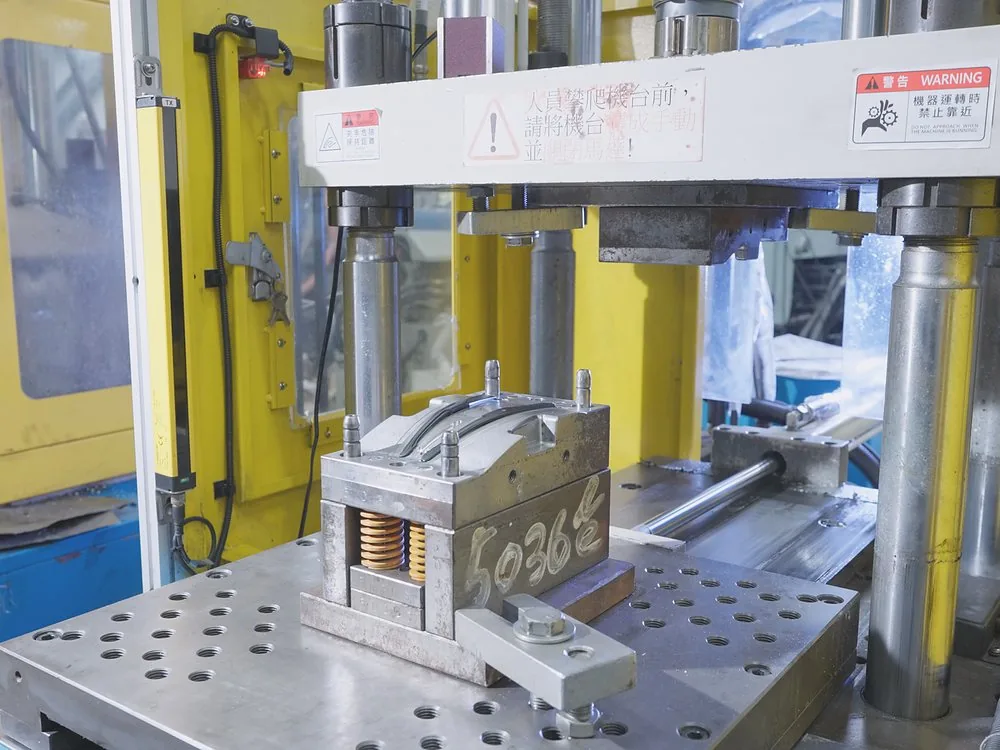
Of 19 injection molding machines on site, 11 are horizontal and 8 are vertical. The vertical presses exist for this work.
A vertical press opens upwards, so an insert sits in the cavity under its own weight and stays where it was placed. On a horizontal press it would have to be clamped by a fixture against gravity. That is why insert and over-molding work runs on vertical machines everywhere it is done properly, and it is why we have eight of them rather than a jig on a horizontal press.
Typical applications
- Temple tips
- Nose pads and nose bridges
- Temple grips and inner surfaces
- Soft-touch zones on sports frames
Soft materials
- TPR
- TPEE
- Recycled TPR
Why not just glue it on
The cheaper route is to mold the soft part separately and bond it with adhesive. It needs no second tool and no second press, and it is what a good deal of the soft-touch eyewear on the market is.
Adhesive is a third material with its own ageing behaviour. It is attacked by sweat, sunscreen and solvents, and it relaxes with heat — a frame left on a dashboard is a worse test than most laboratory cycles. An over-molded grip has no adhesive to attack.
What it needs from the design
Over-molding is a tooling decision, not a finishing option. The rigid part has to be designed with the second shot in mind: mechanical interlocks where the soft material wraps, wall sections that survive the second cycle, and a parting line that falls where the grip ends.
That matters most when a style already exists. A frame tooled for a plain hard temple usually cannot be over-molded without a new tool — the geometry that holds the soft material was never cut into it. We say so when we quote rather than after.
Where the hard part is painted, the paint and the soft material also have to get along. Adhesion between a given TPR grade and a given paint system is confirmed on sampling, not assumed, and it is one of the things first shots are for.
What to send for a quotation
A 2D drawing or 3D file, the rigid material, which areas should be soft, whether the hard part is painted, and a reference for hardness and finish — a sample part is the fastest way to communicate the last one. Tooling and lead times are quoted against the drawing.
Send us the part.
Tell us which surfaces need to be soft and we will come back on tooling, materials and lead time.
Request a quotation